Acrossbridge uses intents to transfer and swap tokens across supported blockchains
· last updated
Acrossbridge is Across Protocol's intent-based bridge for moving tokens and making swaps between supported blockchains. An intent specifies the desired destination outcome, which competing relayers fulfill using their own capital. Its capabilities include same-asset transfers, swaps into another asset, and destination-chain actions, with each combination depending on the selected route and application integration.
The user-facing bridge and embedded app flows expose different parts of this infrastructure. The output asset defines what arrives, while an attached action defines what happens after delivery. Both choices affect the request's requirements and completion.
Token movement and destination execution
Across supports same-asset bridging, cross-chain swaps, and transfers that include an action on the destination chain. Same-asset bridging changes the network holding the funds. A cross-chain swap changes the asset received as well as the network. An embedded action can use delivered funds for a contract call, such as an Aave deposit. A swap-plus-execution intent can omit the destination action. Embedded Swap API actions can combine destination token transfers, DeFi deposits, and other contract calls with cross-chain delivery.
Swap API embedded actions execute after token delivery within the same destination transaction. Origin escrow and destination fulfillment occur on different chains, so packaging the operations into one request does not make the whole cross-chain process atomic. A plain transfer can end at asset delivery without an attached app transaction.
Bridge access and application integrations
Across is accessible through its wallet-connected bridge and integrations inside other applications, including Uniswap. Supported networks include Ethereum, Base, Solana, and BNB Smart Chain. A route also needs support for the selected token combination. An app's integration determines which protocol capabilities appear in its interface, so direct bridging and integrated execution can expose different choices.
Amount selection in the Swap API
The Swap API's trade type determines which token the amount describes. It uses the input token's smallest units for
exactInput
, and the output token's smallest units for
minOutput
or
exactOutput
.
A fixed input amount
An
exactInput
request fixes the amount spent. Its output varies with fees, slippage, and exchange rates.
Minimum and exact output
A
minOutput
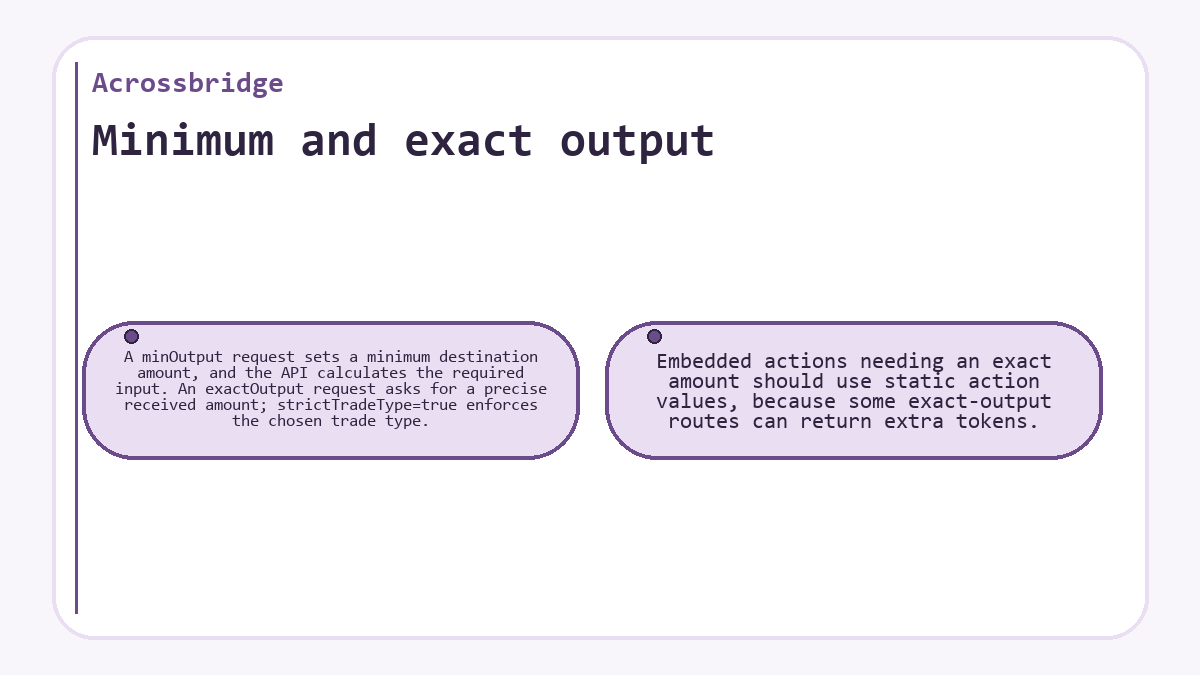
request sets a minimum destination amount, and the API calculates the required input. An
exactOutput
request asks for a precise received amount;
strictTradeType=true
enforces the chosen trade type. Embedded actions needing an exact amount should use static action values, because some exact-output routes can return extra tokens.
From deposit to fill and settlement
An Across transfer separates origin initiation, destination fill, and later settlement. A confirmed deposit records the origin-side request; destination delivery has its own fill.
| Stage | Protocol action | Outcome or recovery condition |
|---|---|---|
| Initiation | The origin SpokePool escrows input tokens and records the requested destination output. | The deposit identifies the request; it does not establish a destination fill. |
| Fill | A relayer supplies tokens on the destination chain. | A fill delivers the requested output; unfilled expiry leads to a separate refund process. |
| Settlement | The protocol verifies fills and processes relayer repayment. | An expired deposit qualifies for a refund only if no fill, including a partial fill, occurred. |
The fill is the user's token-delivery event. Settlement repays relayers in the background, allowing delivery to happen first. Expiry alone does not mean escrowed funds have returned: the expired and refunded states describe different outcomes. For a request with an attached destination action, the intended outcome also includes that action.
What determines the cost of an Across transfer?
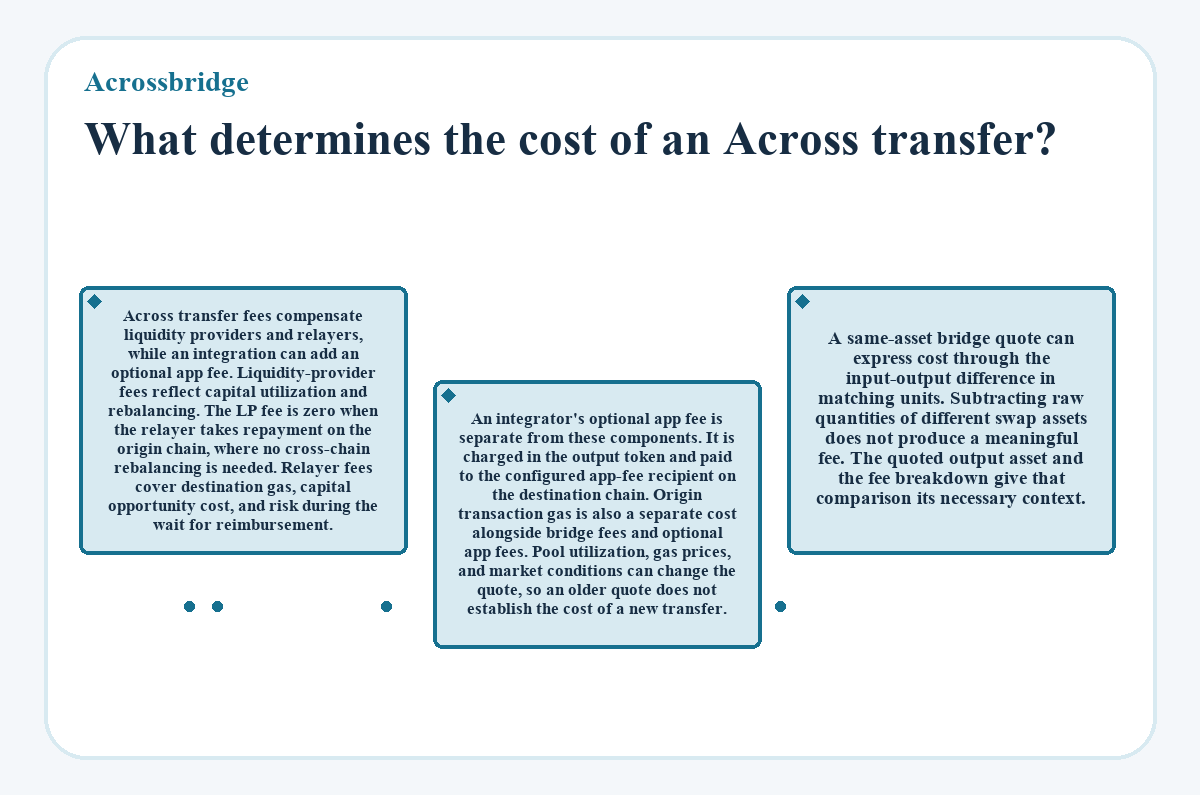
Across transfer fees compensate liquidity providers and relayers, while an integration can add an optional app fee. Liquidity-provider fees reflect capital utilization and rebalancing. The LP fee is zero when the relayer takes repayment on the origin chain, where no cross-chain rebalancing is needed. Relayer fees cover destination gas, capital opportunity cost, and risk during the wait for reimbursement. An integrator's optional app fee is separate from these components. It is charged in the output token and paid to the configured app-fee recipient on the destination chain.
Origin transaction gas is also a separate cost alongside bridge fees and optional app fees. Pool utilization, gas prices, and market conditions can change the quote, so an older quote does not establish the cost of a new transfer.
A same-asset bridge quote can express cost through the input-output difference in matching units. Subtracting raw quantities of different swap assets does not produce a meaningful fee. The quoted output asset and the fee breakdown give that comparison its necessary context.
How quickly can Acrossbridge deliver tokens?
Acrossbridge can deliver tokens within seconds through relayer-funded fills, while settlement happens afterward. Relayers front their own capital to fulfill destination transfers. The advertised wallet-delivery metric begins at confirmation. It excludes the preceding time spent preparing and confirming the origin transaction.
An integration can show an estimated fill time for the selected quote. That estimate describes destination delivery, not a deadline for relayer reimbursement. Refunds after unfilled expiry require settlement processing and may take several hours. That refund timetable applies to eligible expired deposits and is separate from the speed of a successful fill.
V4 settlement and verification risk
Across V4 changes settlement message verification and delivery while retaining the initiation and fill model. It uses zero-knowledge proofs through Succinct's SP1 proving system to verify Ethereum state on destination chains. V3 uses chain-specific adapters and canonical bridges for that settlement path.
Across V4 retains UMA's Optimistic Oracle for verifying repayment bundles on Ethereum. Its proof-based destination message delivery follows the bundle-verification stage. Ethereum finality and proof generation remain part of that settlement path, even though the user can receive a relayer-funded fill earlier.
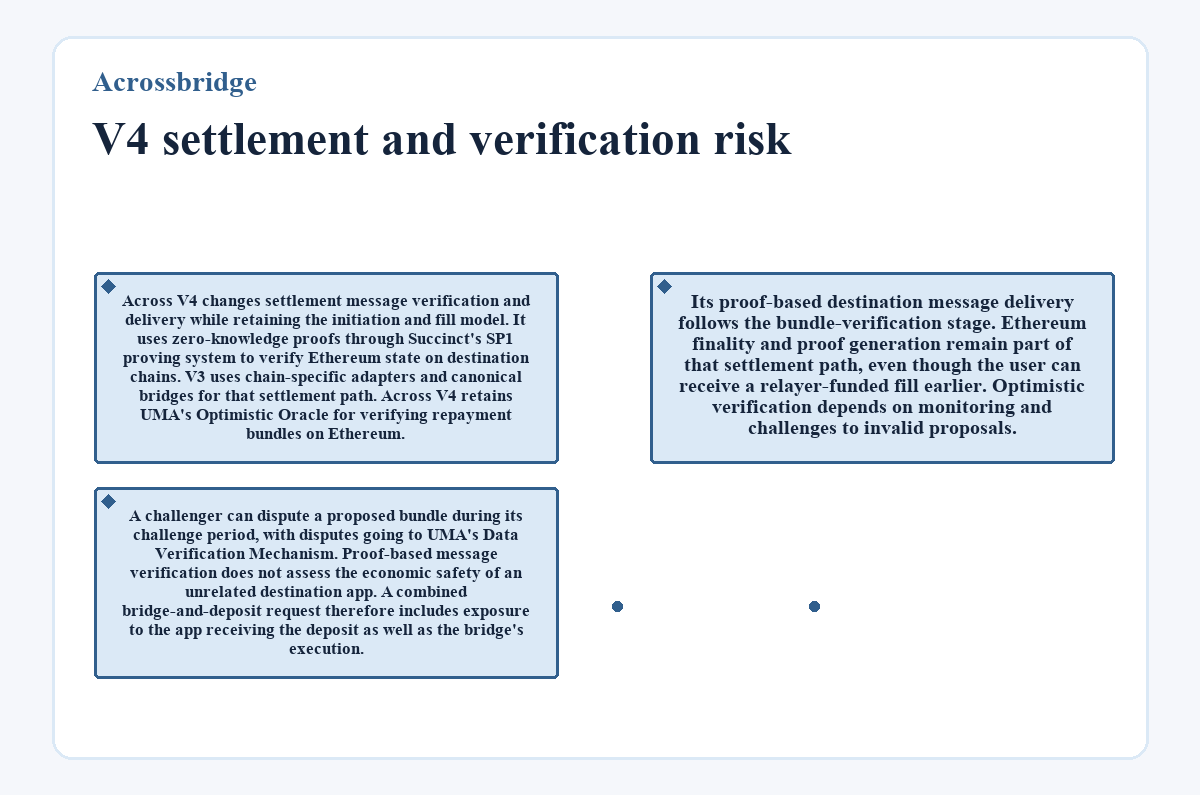
Optimistic verification depends on monitoring and challenges to invalid proposals. A challenger can dispute a proposed bundle during its challenge period, with disputes going to UMA's Data Verification Mechanism. Proof-based message verification does not assess the economic safety of an unrelated destination app. A combined bridge-and-deposit request therefore includes exposure to the app receiving the deposit as well as the bridge's execution.
Protocol governance and standardized intents
Across launched ACX in late 2022 for decentralized ownership and protocol governance. The token also supports ecosystem growth incentives.
ERC-7683 provides a standardized format for cross-chain intent orders. Across and Uniswap Labs co-authored the standard to support interoperability between intent systems. The order describes the input and output tokens, amounts, chains, and recipient.
Across implements ERC-7683 through AcrossOriginSettler, an on-chain entry point that validates order parameters and creates SpokePool deposits. Direct contract integrations use it for on-chain composability. The Swap API returns encoded transaction data, any required approval transactions, and gas estimates for application integrations; a direct contract caller must supply correctly encoded order data.
Questions people ask about Acrossbridge
Can an Across transfer send tokens to a different recipient?
A plain transfer can specify a destination recipient that differs from the depositing wallet. The Swap API otherwise defaults the recipient to the depositor. Embedded-action requests use the destination MulticallHandler contract as the recipient. For a subsequent token-transfer action, the transfer's recipient belongs in that action's arguments.
Where does an expired deposit's refund go?
The Swap API selects the refund chain from route type unless an explicit refundOnOrigin value overrides it. The API defaults bridgeableToBridgeable and anyToBridgeable refunds to the origin chain. It defaults bridgeableToAny and anyToAny refunds, which involve a destination swap, to the destination chain. Refund recipients follow this priority: an explicit refundAddress, then recipient, then depositor.
Why can the deposit status lag behind a fast fill?
The status indexer can report a fill after it has already occurred on-chain. A short indexing delay can leave the API showing a pending state temporarily. The destination fill transaction records delivery, while an origin transaction hash identifies the deposit that tracking must locate. A delay in that status update does not, by itself, establish a failed transfer.
How is risk Labs connected to Across protocol?
Risk Labs is the foundation and team behind Across. Its 2019 founding predates Across's same-asset bridging, which began in 2021. Across subsequently expanded from a bridge into cross-chain interoperability infrastructure.
Does Across support bridge-and-stake or bridge-and-mint integrations?
Across supports application integrations that combine bridging with staking or minting. These are uses of its cross-chain infrastructure, and an individual app must implement the relevant destination transaction. Protocol-level support for bridge-and-stake does not mean every transfer screen offers staking, or that every staking or minting contract is a supported target.